🎙️ Quantum Computing Explained – Audio Version
Listen to this beginner-friendly narration covering quantum computing fundamentals, real-world examples, current challenges, career opportunities, and the future of this revolutionary technology.
Quantum Computing Explained is one of the most exciting topics in modern technology. Whether you’re a student, professional, or simply curious about the future, understanding quantum computing can help you explore how scientists are solving some of today’s most complex computational challenges. This beginner-friendly guide explains the concepts in simple language with practical examples.
If you’ve ever wondered why quantum computing is making headlines, here’s the short answer: it represents a new approach to solving certain complex problems that are difficult or impractical for today’s classical computers.
Unlike traditional computers, which process information using bits (0s and 1s), quantum computers use qubits, which follow the principles of quantum mechanics. This unique approach may help researchers tackle specialized problems in fields such as medicine, chemistry, logistics, materials science, and optimization. However, quantum computers are not expected to replace laptops or smartphones for everyday tasks.
This guide explains the technology in simple language, explores where it may be useful, and separates realistic expectations from common misconceptions.
Introduction
Technology has evolved at an incredible pace over the past few decades. Many of us have witnessed the transition from desktop computers to smartphones, from dial-up internet to high-speed fiber connections, and from simple search engines to artificial intelligence that can assist with writing, coding, and research. Each of these milestones changed how people work, learn, and communicate.
Now, researchers are exploring another frontier: quantum computing.
Unlike many emerging technologies, quantum computing is not simply about making existing computers faster. Instead, it introduces a fundamentally different way of processing information by applying the principles of quantum mechanics—the branch of physics that studies matter and energy at extremely small scales.
At first glance, the topic can seem intimidating. Terms like qubits, superposition, and entanglement often appear in articles and videos, making the subject sound highly technical. Fortunately, you don’t need a degree in physics to understand the basic ideas. With the right explanations and a few everyday analogies, the concepts become much easier to grasp.
One of the reasons quantum computing has captured global attention is its potential to address specialized challenges that are difficult for today’s computers. Researchers are investigating whether quantum systems could improve molecular simulations, optimize supply chains, assist with certain optimization problems, and advance scientific discovery. At the same time, experts emphasize that the technology is still developing, and many engineering challenges remain before large-scale, fault-tolerant quantum computers become practical.
Understanding both the possibilities and the limitations is important. Quantum computing should not be viewed as a magical solution to every computational problem. Instead, it is best understood as a specialized tool that may complement classical computers in specific domains.
Whether you are a student, technology enthusiast, business professional, or simply curious about the future, learning the basics of quantum computing can help you better understand one of the most discussed research areas in modern science.
Quantum Computing Explained helps readers understand not only how this technology works but also why it has become one of the most discussed topics in modern science and computing.
Quantum Computing Explained: What Is It?
Researchers around the world are exploring quantum computing to better understand chemical reactions, improve optimization methods, and simulate physical systems that are challenging for classical computers. While progress continues, most current quantum devices are still experimental and are often accessed through cloud-based research platforms rather than used as everyday computers.
What Is Quantum Computing?
This Quantum Computing Explained guide is designed for beginners who want clear explanations without advanced mathematics or physics.
Quantum computing is a field of computing that uses the principles of quantum mechanics to process information in ways that differ from classical computers.
Traditional computers represent information using bits, where each bit is either 0 or 1. Quantum computers use quantum bits, commonly called qubits. Because qubits behave according to quantum mechanics, they can represent information differently from classical bits and enable algorithms designed for certain specialized problems.
It is important to understand that quantum computers are not intended to replace the computers we use every day. For activities such as browsing the internet, writing documents, streaming videos, gaming, or checking email, classical computers remain the most practical and efficient choice.
Instead, quantum computers are being researched for tasks such as:
- Simulating molecules for drug discovery
- Optimizing complex logistics and transportation networks
- Studying advanced materials
- Exploring certain machine learning techniques
- Supporting scientific and engineering research
Why Quantum Computing Explained Matters Today
Imagine you are searching for the fastest route to deliver thousands of packages across a large country.
A classical computer can evaluate many possible routes using well-established algorithms. A quantum computer is being researched for certain optimization problems where quantum algorithms may provide advantages under specific conditions. It is not guaranteed to outperform classical methods in every routing scenario, but it offers a different computational approach that researchers continue to study.
This analogy is simplified, but it illustrates that quantum computing is about solving particular types of complex problems, not accelerating every task.
Quantum Computing Explained Through Real-Life Examples
As scientific questions become more complex, researchers often require enormous computing power to model systems accurately. Simulating molecules, designing new materials, or solving intricate optimization problems can demand significant computational resources.
Quantum computing is being explored because it may help with some of these specialized challenges.
1. Drug Discovery
Developing a new medicine can take many years of laboratory research and testing. Scientists often rely on computer simulations to understand how molecules interact before moving to experiments.
Researchers are investigating whether quantum computers could improve simulations of molecular systems, potentially supporting parts of the drug discovery process. They are expected to complement—not replace—laboratory experiments and classical computing.
Real-World Example: Pharmaceutical researchers use advanced computing to study protein structures and chemical interactions. Quantum computing is an active area of research for enhancing certain molecular simulations.
2. Climate and Environmental Research
Climate systems involve countless interacting variables, making accurate modeling a major scientific challenge.
Researchers are exploring whether quantum techniques could contribute to more efficient simulations in areas such as weather prediction, climate science, and energy systems, alongside existing supercomputers.
3. Smarter Transportation and Logistics
Every day, logistics companies determine routes for trucks, ships, and aircraft while balancing costs, time, fuel consumption, and delivery schedules.
Optimization problems of this kind are an important area of quantum computing research. Even small improvements in routing efficiency could reduce costs and environmental impact when applied at large scales.
4. Artificial Intelligence
Artificial intelligence relies heavily on processing large amounts of data and solving mathematical optimization problems.
Researchers are studying how quantum algorithms might complement some AI techniques in the future. Quantum computing is not expected to replace AI; rather, the two fields may work together in specialized applications.
Benefits of Quantum Computing Explained
Some organizations already provide cloud access to experimental quantum computers, allowing students, researchers, and developers to learn about quantum programming and run small experiments without owning quantum hardware.
How Are Quantum Computers Different from Classical Computers?
At first glance, a quantum computer may look similar to a highly specialized scientific machine, but the biggest difference lies in how information is processed.
Every smartphone, laptop, and desktop computer you use today relies on classical computing. These devices have become incredibly powerful and can perform billions of calculations every second.
Quantum computers, however, are designed for a different purpose. They use the principles of quantum mechanics to solve certain types of complex problems that are difficult for classical computers.
Rather than competing with your laptop, quantum computers are expected to work alongside classical computers, each handling the tasks they are best suited for.
Classical Computing vs. Quantum Computing
| Feature | Classical Computer | Quantum Computer |
|---|---|---|
| Information Unit | Bit (0 or 1) | Qubit |
| Everyday Tasks | Excellent | Not designed for everyday computing |
| Web Browsing | ✔ Yes | ✖ No |
| Gaming | ✔ Yes | ✖ No |
| Email & Documents | ✔ Yes | ✖ No |
| Scientific Simulations | Limited for some problems | Potential advantages for specific simulations |
| Optimization Problems | Effective for many tasks | Research suggests advantages for some specialized problems |
| Technology Status | Mature | Early-stage and actively researched |
Key Takeaway
Quantum computers are specialized scientific tools, not replacements for consumer devices.
Understanding Qubits
To understand quantum computing, it’s helpful to start with the basic unit of information.
What Is a Bit?
In a classical computer, everything is represented using bits.
A bit can have only one of two values:
- 0
- 1
Millions or billions of these bits work together to process text, images, videos, and software.
What Is a Qubit?
A qubit, or quantum bit, is the basic unit of information in a quantum computer.
Unlike a classical bit, a qubit behaves according to the laws of quantum mechanics. This allows quantum algorithms to represent and process information in ways that are fundamentally different from classical systems.
Scientists create qubits using different physical technologies, including:
- Superconducting circuits
- Trapped ions
- Neutral atoms
- Photonic (light-based) systems
Each approach has its own advantages and engineering challenges.
Everyday Analogy
Imagine a standard light switch.
It has only two positions:
- OFF
- ON
This is similar to a classical bit.
Now imagine a spinning coin.
While spinning, it is in motion and cannot be described simply as “heads” or “tails” until it settles.
Although this is only an analogy and not a literal description of quantum behavior, it can help beginners appreciate that qubits are different from ordinary bits.
Superposition Explained Simply
One of the most frequently discussed ideas in quantum computing is superposition.
The term sounds complicated, but the basic idea is easier to understand with an analogy.
Think About Music
Imagine listening to a piano.
One musician can play a single note.
Another musician can play several notes together to create a chord.
The chord contains multiple notes at the same time, creating richer possibilities than a single note alone.
Similarly, superposition allows quantum algorithms to represent computational states differently from classical bits, enabling new approaches to solving certain problems.
Real-Life Example
Suppose a logistics company must evaluate thousands of delivery schedules while considering:
- Distance
- Fuel costs
- Driver availability
- Traffic patterns
- Delivery deadlines
Classical computers already solve these problems very effectively using advanced optimization algorithms.
Researchers are investigating whether quantum algorithms could provide additional advantages for some especially complex optimization problems.
This is one reason why industries are closely following developments in quantum computing.
Did You Know?
Scientists spend a significant amount of effort protecting qubits from tiny disturbances such as heat, vibrations, and electromagnetic interference. Even small environmental changes can introduce errors, which is why many quantum computers operate in highly controlled laboratory conditions.
What Is Quantum Entanglement?
Another key concept is entanglement.
Entanglement describes a special quantum relationship between particles. It is one of the most intriguing features of quantum mechanics and plays an important role in many quantum computing approaches.
While the mathematics behind entanglement is advanced, the basic idea can be introduced with an everyday comparison.
A Simple Analogy
Imagine two dancers performing a carefully choreographed routine.
Even when they move apart on the stage, their actions remain coordinated according to the choreography.
This analogy is not a scientific description of entanglement, but it helps illustrate the idea that quantum systems can exhibit correlations that differ from those found in everyday classical objects.
Why Is Entanglement Useful?
Researchers use entanglement to build quantum algorithms that take advantage of quantum mechanical properties for specific computational tasks.
Potential research areas include:
- Quantum communication
- Quantum cryptography
- Quantum sensing
- Certain quantum computing algorithms
What Are Quantum Gates?
Just as classical computers use logic gates (such as AND, OR, and NOT) to process bits, quantum computers use quantum gates to manipulate qubits.
Quantum gates perform operations that change the state of qubits according to the principles of quantum mechanics.
These gates are the building blocks of quantum circuits, which are the quantum equivalent of programs.
Live Examples of Quantum Computing Research
1. Healthcare and Drug Discovery
Researchers are exploring how quantum computing could improve simulations of molecular interactions, potentially supporting the search for new medicines.
For example, scientists studying protein behavior or chemical reactions may eventually benefit from more accurate quantum simulations for certain problems.
2. Financial Services
Banks and financial institutions routinely solve optimization problems, such as balancing investment portfolios or managing financial risk.
Quantum computing is being investigated as a possible tool for some of these complex calculations, though practical deployment is still an area of ongoing research.
3. Logistics and Transportation
Imagine a delivery company managing:
- 50,000 packages
- Thousands of vehicles
- Fuel costs
- Traffic conditions
- Weather updates
Optimizing these factors is computationally challenging.
Quantum algorithms are being researched to determine whether they can improve solutions for certain large-scale optimization tasks.
4. Materials Science
Designing stronger batteries, lighter materials, or more efficient solar cells often requires understanding interactions at the molecular level.
Quantum simulations may eventually help researchers study these systems more effectively.
5. Artificial Intelligence
AI and quantum computing are separate technologies, but researchers are exploring how quantum techniques could complement some machine learning methods.
For example, future research may investigate whether quantum algorithms can assist with particular optimization or data analysis tasks.
Expert Tip
Quantum computing is not about making every computer faster. Its greatest potential lies in addressing specialized scientific and mathematical problems where quantum algorithms may offer advantages over classical approaches.
Current Challenges and Limitations of Quantum Computing
Quantum computing has generated significant excitement, but it’s important to understand that the technology is still developing. While researchers have made remarkable progress, several technical challenges must be overcome before large-scale, fault-tolerant quantum computers become widely practical.
1. Error Rates
Qubits are extremely sensitive to their environment. Small disturbances—such as temperature changes, vibrations, or electromagnetic noise—can introduce errors into calculations.
Researchers are actively developing quantum error correction techniques to make quantum systems more reliable.
2. Scalability
Building a quantum computer with a small number of qubits is very different from building one with thousands or millions of reliable qubits.
Scaling quantum hardware while maintaining accuracy remains one of the field’s biggest engineering challenges.
3. Cost and Infrastructure
Many current quantum computers operate at extremely low temperatures using specialized cooling equipment. These systems require advanced laboratory infrastructure and are expensive to build and maintain.
As research continues, scientists hope to improve both the performance and accessibility of quantum hardware.
4. Specialized Use Cases
Quantum computers are not universal speed boosters.
Many everyday tasks—including web browsing, word processing, video editing, and email—are already handled efficiently by classical computers. Quantum computers are expected to complement classical systems by addressing specific classes of computational problems.
Myth vs. Fact
| Myth | Fact |
|---|---|
| Quantum computers will replace laptops. | They are designed for specialized research and computation, not everyday personal computing. |
| Quantum computers can solve every problem instantly. | They may offer advantages for certain problems, but not all computational tasks. |
| Quantum computing is already widely available. | Access exists mainly through research institutions and cloud-based experimental platforms. |
| Quantum computing will eliminate artificial intelligence. | AI and quantum computing are separate fields that may complement each other in some applications. |
| Only physicists can learn quantum computing. | Beginners can start with basic concepts and gradually explore programming and mathematics. |
Companies and Organizations Advancing Quantum Research
Several organizations are contributing to the development of quantum technologies through research, hardware, software, and cloud access.
Some examples include:
- IBM
- Microsoft
- Amazon (through cloud quantum services)
- Intel
- Rigetti Computing
- IonQ
- Quantinuum
- D-Wave
- Universities and national research laboratories around the world
Each organization focuses on different hardware technologies, software tools, or research goals, reflecting the diversity of approaches in the field.
Career Opportunities in Quantum Computing
As quantum technologies continue to evolve, interest in related careers is growing. Many roles combine knowledge from computer science, physics, mathematics, engineering, and data science.
Examples include:
- Quantum Software Developer
- Quantum Algorithm Researcher
- Quantum Hardware Engineer
- Quantum Information Scientist
- Machine Learning Researcher
- Cybersecurity Specialist (Post-Quantum Cryptography)
- Research Scientist
- Systems Engineer
- Technical Writer for Quantum Technologies
- University Lecturer or Academic Researcher
Students interested in quantum computing can begin by strengthening their foundations in mathematics, programming, and computer science before exploring specialized quantum concepts.
Tips for Beginners
If you’re new to quantum computing, don’t worry about mastering everything at once.
A practical learning path could be:
- Learn the basics of classical computing.
- Build programming skills with languages such as Python.
- Understand introductory linear algebra and probability.
- Study the fundamentals of quantum mechanics at a beginner level.
- Explore introductory quantum programming frameworks and tutorials.
- Practice by running simple quantum circuits on educational cloud platforms.
Learning gradually is often more effective than trying to understand advanced topics immediately.
Key Takeaways
- Quantum computing uses qubits, which behave differently from classical bits.
- It is designed to address certain specialized computational problems rather than replace everyday computers.
- Potential application areas include scientific simulation, optimization, materials research, and aspects of machine learning.
- The technology is still evolving, and many engineering challenges remain.
- Researchers, universities, governments, and technology companies continue to invest in advancing quantum computing.
- If you’re still new to the subject, these frequently asked questions will reinforce the key ideas covered throughout this Quantum Computing Explained article.
Quantum Computing Explained FAQs
1. What is quantum computing in simple terms?
Quantum computing is a different approach to computing that uses the principles of quantum mechanics to solve certain specialized problems more efficiently than classical computers.
2. Will quantum computers replace laptops and smartphones?
No. Classical computers remain the best choice for everyday tasks such as browsing, email, gaming, and office work. Quantum computers are intended for specialized applications.
3. What is a qubit?
A qubit is the basic unit of information in a quantum computer. Unlike a classical bit, it follows the principles of quantum mechanics.
4. Why is quantum computing important?
Researchers believe it may improve simulations, optimization, and scientific research in areas such as chemistry, materials science, and logistics.
5. Is quantum computing available today?
Yes, but most systems are experimental and are primarily used by researchers, universities, and organizations through cloud-based platforms.
6. Which industries may benefit from quantum computing?
Healthcare, finance, logistics, energy, materials science, cybersecurity, and scientific research are among the areas being explored.
7. Is quantum computing the same as artificial intelligence?
No. They are different technologies. Researchers are studying how they might complement each other in some specialized applications.
8. Can beginners learn quantum computing?
Yes. A background in programming, mathematics, and basic physics can help, but many beginner-friendly educational resources are available.
9. Why do quantum computers need special environments?
Qubits are sensitive to external disturbances, so many quantum systems operate in carefully controlled conditions to reduce errors.
10. Is quantum computing secure?
Quantum computing has implications for cybersecurity, including the development of post-quantum cryptography, which aims to protect information against future quantum-enabled attacks.
11. What is post-quantum cryptography?
It refers to cryptographic methods designed to remain secure against both classical and future quantum computers.
12. What should students learn first?
Programming, mathematics, computer science fundamentals, and introductory quantum concepts provide a strong foundation.
Conclusion
Quantum computing represents one of the most fascinating areas of modern scientific research. Rather than replacing the computers we use every day, it offers a new way to approach specific computational challenges that arise in fields such as chemistry, optimization, materials science, and engineering.
Although the technology is still developing, it has already inspired collaboration among researchers, universities, governments, and technology companies worldwide. Continued advances in hardware, algorithms, and error correction will shape how quantum computing evolves over the coming years.
For students, professionals, and technology enthusiasts, now is an excellent time to build a foundational understanding of quantum computing. By learning the core concepts today, you’ll be better prepared to follow future developments in a field that continues to push the boundaries of science and innovation.We hope this Quantum Computing Explained guide has given you a solid foundation for understanding one of today’s most exciting research fields. As Quantum Computing Explained continues to evolve, staying informed will help you follow future developments with confidence.As Quantum Computing Explained continues to evolve through ongoing research, staying informed will help you follow one of the most exciting areas of modern technology.
Organizations such as IBM Quantum, Google Quantum AI, and Microsoft Azure Quantum provide educational resources, cloud access, and research updates that help students and developers learn more about quantum computing. Standards bodies such as NIST are also working on post-quantum cryptography to prepare for future advances in computing
Link to trusted educational and research organizations. Here are good choices:
- IBM Quantum – https://quantum.ibm.com/
- Google Quantum AI – https://quantumai.google/
- Microsoft Azure Quantum – https://azure.microsoft.com/products/quantum
- NIST (Post-Quantum Cryptography) – https://www.nist.gov/pqcrypto
- MIT OpenCourseWare – https://ocw.mit.edu/
- CERN – https://home.cern/
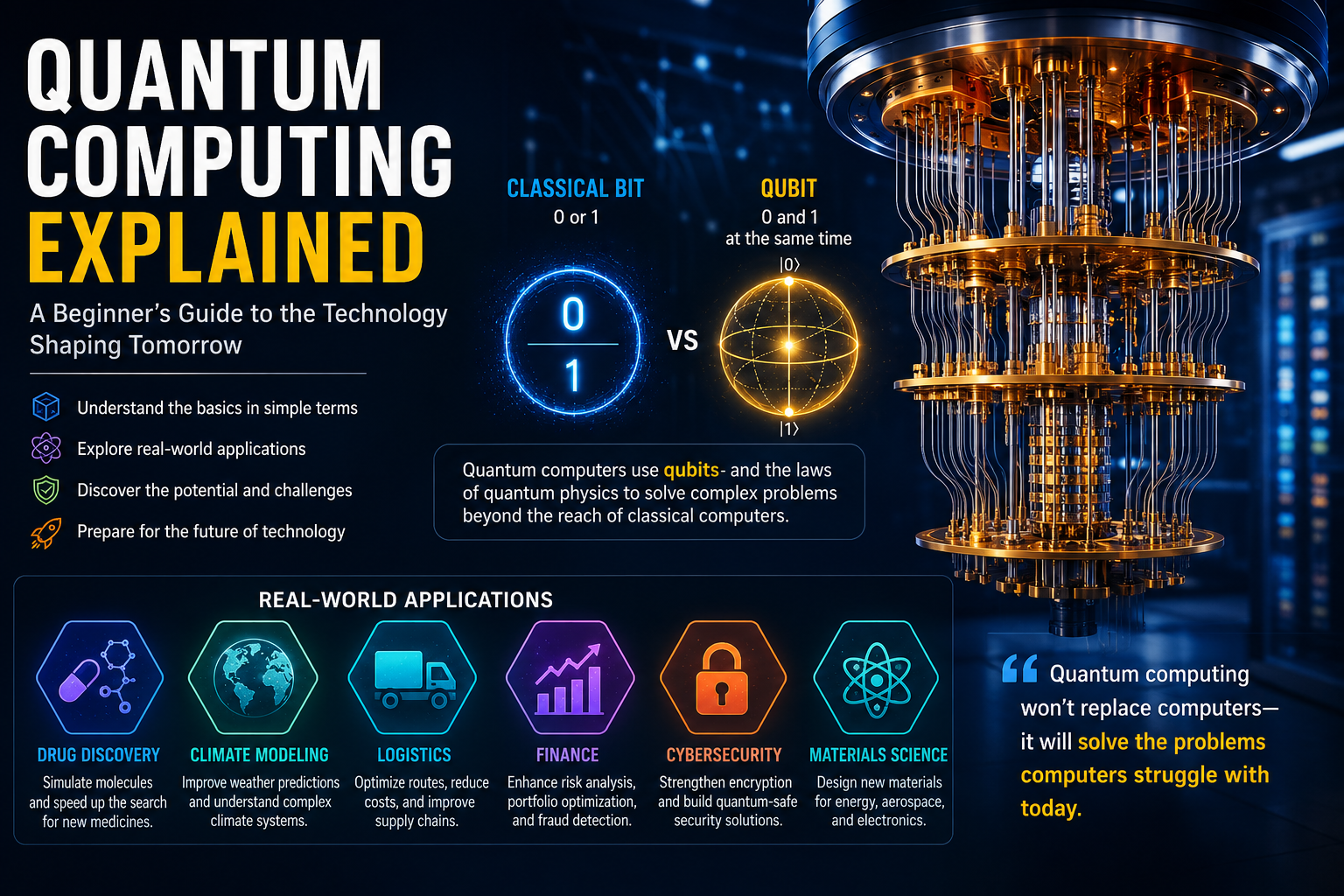
Conceptual illustration of a quantum computer showing qubits, classical bits versus qubits, and potential applications in healthcare, AI, cybersecurity, logistics, finance, and materials science.”
- Quantum Computing Explained: 15 Amazing Facts Every Beginner Should Know
- ⚛️ Quantum Internet 2026: The Race to Build the World’s First Unhackable Digital Network
- ⚛️ Quantum Technology in 2026: The Scientific Revolution That Could Change Humanity Forever
- Quantum Computing Explained 2026: Powerful Beginner Guide to Future Technology
- Future Technology Trends 2026: Welcome to Quantum Hub Tech
🎥 Quantum Computing Explained: 15 Amazing Facts Every Beginner Should Know
🚀 Ready to explore the future of computing?
In this video, you’ll discover 15 amazing facts about quantum computing that every beginner should know. Learn how qubits, superposition, and quantum entanglement are transforming technology and solving problems that today’s most powerful supercomputers cannot handle.
Whether you’re a student, tech enthusiast, AI learner, or simply curious about the next technological revolution, this easy-to-understand guide will help you grasp the fundamentals of quantum computing.
🌟 In this video you’ll learn:
✅ What is Quantum Computing?
✅ How Qubits Work
✅ Superposition Explained Simply
✅ Quantum Entanglement
✅ Real-World Applications
✅ AI and Quantum Computing
✅ Cybersecurity & Cryptography
✅ Healthcare & Drug Discovery
✅ Financial Modeling
✅ The Future of Quantum Technology
💡 If you enjoyed this video, please:
👍 Like
💬 Comment your favorite fact
📢 Share with friends
🔔 Subscribe for more AI, Quantum Computing, Blockchain, and Emerging Technology content.
📖 Read the full article on your website for more in-depth insights.
#QuantumComputing #QuantumTechnology #Qubits #ArtificialIntelligence #AI #Technology #FutureTech #MachineLearning #Blockchain #Innovation #Science #ComputerScience #QuantumPhysics #BeginnerGuide #TechEducation