Table of Contents
- What Is Quantum Computing?
- How Quantum Computers Work
- Qubits, Superposition, and Entanglement
- Real-World Applications
- Future Outlook
- Frequently Asked Questions
- Conclusion
Introduction: Why Quantum Computing Matters Today
Quantum Computing Explained 2026 is your complete guide to understanding one of the most important technologies of the future. In this educational article, you will learn how quantum computers work, what qubits are, how superposition and entanglement function, and why this technology matters in fields like healthcare, cybersecurity, finance, and artificial intelligence.
Quantum computing is no longer a futuristic idea—it is becoming one of the most important technological breakthroughs of the 21st century. While classical computers have powered our digital world for decades, they are reaching their limits when solving extremely complex problems.
Quantum computing introduces a completely different way of processing information. Instead of using traditional bits (0s and 1s), quantum computers use qubits, which can exist in multiple states simultaneously. This unique capability allows them to solve problems that would take classical computers thousands—or even millions—of years.
Major technology companies like IBM, Google, and Microsoft are investing billions into quantum research. Governments and startups are also entering the race, making quantum computing a global priority.
In this guide, you will learn everything from the basics to advanced concepts in a simple, structured way
Quantum Computing Explained 2026 is one of the most important emerging topics in modern technology. This guide on Quantum Computing Explained 2026 helps readers understand how qubits, superposition, and entanglement work in real-world systems. By learning Quantum Computing Explained 2026, you can stay ahead in fields like artificial intelligence, cybersecurity, and advanced computing innovations.
.
 Also read: Artificial Intelligence Trends in 2026
What Is Quantum Computing?
Quantum Computing Explained 2026: What It Really Means
Quantum computing is a type of computation based on the principles of quantum mechanics, the branch of physics that studies how particles behave at the smallest scales.
Unlike classical computers, which process information in a linear and predictable way, quantum computers leverage phenomena like:
- Superposition
- Entanglement
- Quantum interference
These principles allow quantum machines to process vast amounts of data simultaneously.
For more insights, explore our guide on Future Technology Innovations.Classical vs Quantum Computers
Quantum Computing Explained 2026 for Beginners
Let’s understand the key difference:
| Feature | Classical Computer | Quantum Computer |
|---|---|---|
| Data Unit | Bit (0 or 1) | Qubit (0, 1, or both) |
| Processing | Sequential | Parallel |
| Speed | Limited for complex problems | Extremely fast for specific tasks |
| Applications | Everyday computing | Advanced simulations, cryptography |
Classical computers are still essential, but quantum computers are designed for specialized, high-complexity problems.
Understanding Qubits: The Core of Quantum Computing
Quantum Computing Explained 2026 and Real-World Applications
A qubit (quantum bit) is the basic unit of quantum information.
Unlike a regular bit:
- A bit = either 0 or 1
- A qubit = 0, 1, or both at the same time
This property is called superposition.
Superposition: Doing Many Calculations at Once
Why Quantum Computing Explained 2026 Matters Today
Quantum Computing Explained 2026 vs Classical Computing
Superposition allows a qubit to exist in multiple states simultaneously.
Think of it like a spinning coin:
- When still → heads or tails
- When spinning → both states at once
This enables quantum computers to explore multiple possibilities at the same time, dramatically increasing computational power.
Entanglement: The Quantum Connection
Entanglement is another powerful feature.
When two qubits become entangled:
- The state of one instantly affects the other
- Even if they are far apart
This creates a deep level of coordination between qubits, allowing complex computations to be performed efficiently.
Quantum Gates and Circuits
Quantum computers use quantum gates to manipulate qubits.
These gates:
- Change probabilities
- Control superposition
- Create entanglement
A sequence of these operations forms a quantum circuit, similar to logic circuits in classical computing but far more powerful.
Real-World Applications of Quantum Computing
Quantum Computing Explained 2026: Future Outlook
Quantum computing is not just theoretical—it is already being tested in real-world applications.
1. Cryptography and Cybersecurity
Quantum computers could:
- Break traditional encryption methods
- Enable ultra-secure communication systems
This is why researchers are working on quantum-safe encryption.
Quantum Computing Explained 2026 is becoming one of the most searched and important topics in modern technology. As industries rapidly adopt advanced systems, understanding Quantum Computing Explained 2026 helps individuals stay ahead in innovation, research, and digital transformation. This guide on Quantum Computing Explained 2026 ensures that readers gain practical and future-ready knowledge.
2. Drug Discovery and Healthcare
Quantum simulations can:
- Model molecular interactions
- Accelerate drug discovery
- Improve personalized medicine
This could reduce years of research into months.
3. Financial Modeling
Banks and hedge funds can use quantum computing for:
- Risk analysis
- Portfolio optimization
- Fraud detection
4. Artificial Intelligence and Machine Learning
Quantum computing can enhance AI by:
- Speeding up training processes
- Handling complex datasets
- Improving prediction accuracy
5. Climate and Energy Solutions
Quantum models can help:
- Predict climate patterns
- Optimize renewable energy systems
- Improve battery technology
Current Limitations of Quantum Computing
Despite its potential, quantum computing is still in the early stages.
Key challenges include:
1. Hardware Instability
Qubits are extremely sensitive to environmental disturbances.
2. Error Rates
Quantum calculations can produce errors due to noise.
3. Scalability
Building large-scale quantum systems is difficult and expensive.
4. Cooling Requirements
Quantum computers require temperatures close to absolute zero.
Types of Quantum Computers
Quantum Computing Explained 2026: Applications in Real World
There are different approaches to building quantum computers:
1. Superconducting Qubits
Used by companies like IBM and Google.
2. Trapped Ions
Highly accurate but slower systems.
3. Photonic Quantum Computers
Use light particles for computation.
4. Topological Quantum Computers
An experimental approach led by Microsoft.
Quantum Computing vs Artificial Intelligence
Quantum Computing Explained 2026: Key Challenges and Limitations
While both are advanced technologies, they serve different roles:
- AI → learns from data
- Quantum → processes complex computations
However, combining both could create quantum AI, a powerful future technology.
Quantum Computing vs Classical Computing
Quantum Computing Explained 2026 highlights a key difference between classical and quantum systems. Classical computers process data sequentially, while quantum computers process multiple possibilities simultaneously. This makes quantum computing more suitable for complex simulations, optimization problems, and advanced data analysis.
Why This Matters in 2026
Quantum computing is not just theoretical anymore. Businesses, researchers, and governments are investing heavily in this field. Understanding how it works today gives you a long-term advantage in adapting to future technological changes.
Future of Quantum Computing
The future looks promising.
Experts predict:
- Quantum advantage in specific industries within the next decade
- Hybrid systems combining classical and quantum computing
- Wider adoption in research and enterprise sectors
Governments worldwide are launching national quantum missions, showing how important this field has become.
Quantum Computing Explained 2026 continues to evolve as researchers develop more stable and scalable systems. As innovation accelerates, understanding Quantum Computing Explained 2026 becomes essential for adapting to future technological advancements.
How to Start Learning Quantum Computing
Quantum Computing Explained 2026: Applications in Real World
If you want to enter this field, here is a simple path:
Step 1: Learn the Basics
Start with:
- Linear algebra
- Probability
- Basic physics
Step 2: Programming Skills
Learn languages like:
- Python
- Qiskit (by IBM)
Step 3: Online Platforms
Explore quantum simulators and courses.
Step 4: Practice
Work on small quantum algorithms and simulations.
Common Misconceptions About Quantum Computing
Let’s clear some myths:
- ❌ Quantum computers will replace classical computers
- ❌ They can solve every problem instantly
- ❌ They are already widely available
✔ Reality: Quantum computing is specialized and still developing.
Why Quantum Computing Is Important for the Future
Quantum Computing Explained 2026: Key Challenges and Limitations
Quantum computing has the potential to transform industries, solve previously impossible problems, and unlock new scientific discoveries.
From healthcare to cybersecurity, its impact could be revolutionary.
Also explore our guide on Digital Transformation in 2026. Recommended reading: Blockchain Technology ExplainedConclusion
👉
“In summary, this concept plays a key role in Quantum Computing Explained 2026 and its real-world applications.”
Quantum computing represents a fundamental shift in how we approach computation. While still evolving, its potential is enormous.
Understanding it today gives you an advantage for the future—whether you are a student, professional, or tech enthusiast.
The journey of quantum computing has just begun, and the next decade will likely redefine what technology can achieve.
Quantum Computing Explained 2026 – Frequently Asked Questions (FAQ)
Frequently Asked Questions (FAQ) – Quantum Computing Explained 2026
1. “What is Quantum Computing Explained 2026 in simple terms
Quantum Computing Explained 2026 refers to understanding how advanced computers use qubits instead of traditional bits. Unlike classical systems, quantum computers process multiple possibilities at once using superposition and entanglement, allowing faster solutions to complex problems.
2. How is quantum computing different from classical computing?
Classical computers process tasks step-by-step using bits (0 or 1). Quantum computers use qubits that can exist in multiple states simultaneously. This enables parallel processing, making them more powerful for complex simulations and optimization problems.
3. What are qubits in quantum computing?
Qubits are the basic units of quantum information. They can represent both 0 and 1 at the same time due to superposition, allowing quantum computers to perform many calculations simultaneously.
4. What is superposition in quantum computing?
Superposition allows a qubit to exist in multiple states at once. This enables quantum systems to explore many possible solutions simultaneously instead of one at a time.
5. What is entanglement in quantum computing?
Entanglement is when two or more qubits become connected. A change in one qubit instantly affects the other, enabling efficient and complex computations.
6. What are the real-world uses of quantum computing?
Quantum computing is used in:
- Drug discovery and healthcare
- Financial modeling and risk analysis
- Cybersecurity and encryption
- Artificial intelligence
- Climate modeling and energy optimization
7. Is quantum computing available today?
Yes, but it is still developing. Companies like IBM and Google have built quantum systems mainly for research purposes.
8. Will quantum computers replace classical computers?
No. Quantum computers will complement classical computers, handling complex problems while classical systems manage everyday tasks.
9. Why is quantum computing important for the future?
Quantum computing can solve problems beyond the capability of classical systems, leading to breakthroughs in medicine, finance, and technology.
10. How can beginners start learning quantum computing?
Start with:
Tools like Qiskit from IBM
Mathematics (linear algebra, probability)
Programming (Python)
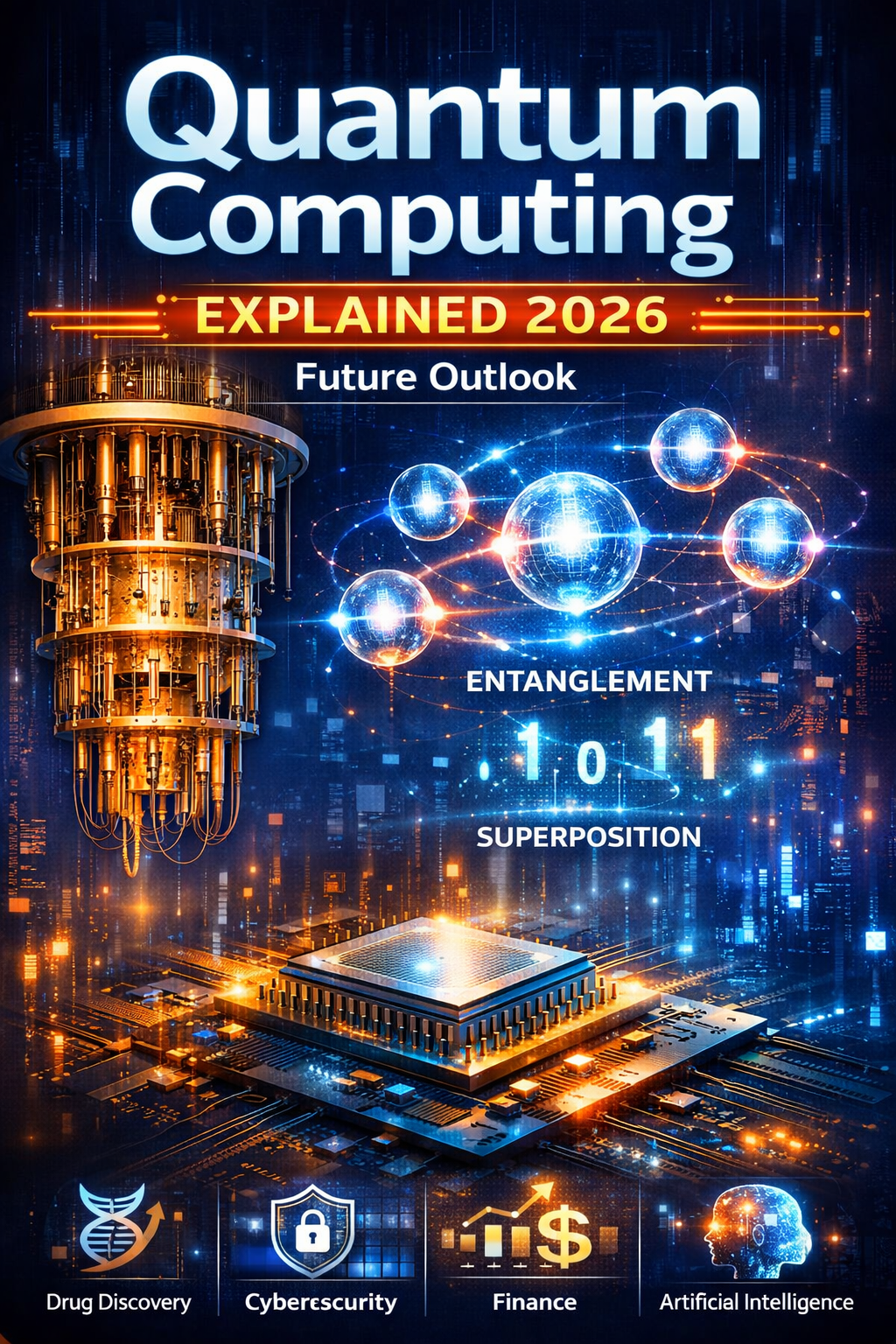
Quantum Computing Explained 2026 showing qubits, superposition, and futuristic computing systems.
🔗 Next Read:
- Artificial Intelligence Trends in 2026
- Future Technology Innovations
- Blockchain Technology Explained
🎧 Quantum Computing Explained 2026: Future Outlook
Discover how quantum technology is shaping the future of AI, healthcare, cybersecurity, and more. Learn the basics of qubits, superposition, and real-world applications in this easy-to-understand guide.
🎬 Quantum Computing Explained 2026: Future Outlook
Discover how quantum computing is transforming the future of technology. In this video, we break down qubits, superposition, and real-world applications in AI, healthcare, cybersecurity, and finance. Learn why Quantum Computing Explained 2026 is one of the most important innovations of our time.
Explore advanced research and innovations at
Google Quantum AI ResearchUnderstand quantum development tools at
Microsoft Quantum Computing SolutionsLearn about quantum-safe encryption at
NIST Quantum Information ScienceFor academic insights, visit
MIT Quantum Science and Engineering